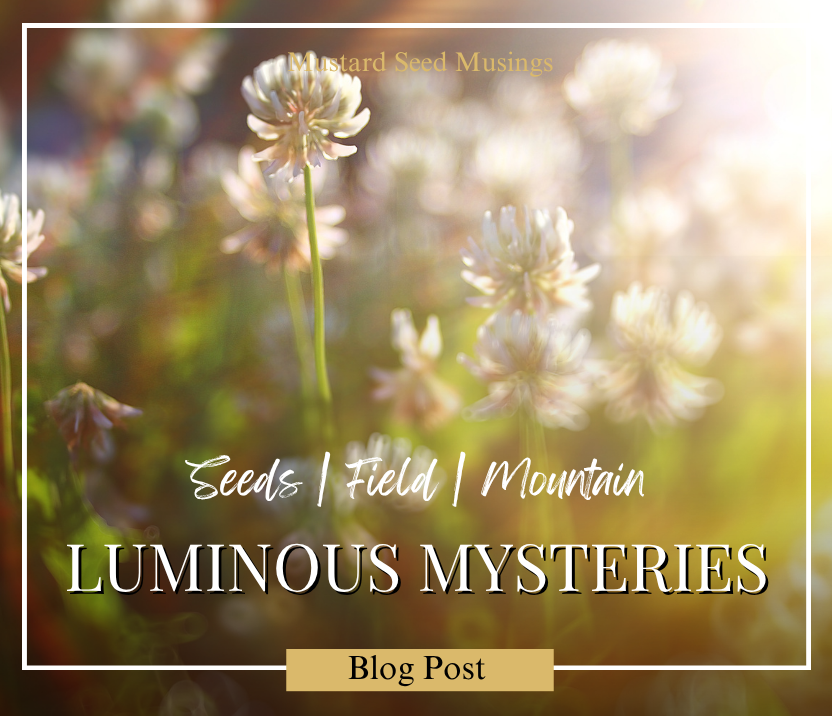
Made new by the light of the world.
The Luminous Mysteries invite contemplation of key moments in Christ’s Public Life. Pope St. John Paul II proposed them in the Apostolic Letter The Rosary of the Virgin Mary, published in October 2002.
In addition to His conception, birth, and childhood, suffering, death, and resurrection, the Luminous Mysteries, or the Mysteries of Light, help us to focus on Jesus’ Public Ministry.
As we meditate on the Mysteries, we walk in Jesus’ footsteps and experience the Rosary’s Christological depth.
The Luminous Mysteries are the works through which Jesus lit the hearts and minds of His disciples and opened the eyes of their faith.
“Again Jesus spoke to them, saying, ‘I am the light of the world; he who follows me will not walk in darkness, but will have the light of life’.”
John 8:12
Darkness comes in many forms and from many directions. Our broken human world always seems to be on the brink of darkness brought on by wars, diseases, misunderstandings, and distrust.
Vices and sin tug at our hearts and souls.
When we look toward the darkness inside our hearts or out in the world, it’s easy to feel defeated, give up, feel too weak, and too small.
“The LORD is my light and my salvation; whom shall I fear? The LORD is the stronghold of my life; of whom shall I be afraid?”
Psalm 27:1
The Light of the World can shatter all darkness. He came to light up all our hearts. We no longer have to fear the dark.
The Baptism of Jesus
“And when Jesus was baptized, he went up immediately from the water, and behold, the heavens were opened and he saw the Spirit of God descending like a dove.’”
Matthew 3:16
The mystery of Jesus’ baptism in the Jordan invites us to meditate on the Holy Spirit’s transformative power.
The Spirit of God is our counselor, advocate, helper, and consoler. Through Baptism, we receive His graces and share in all of God’s promises.
Our hearts and souls become temples where the Spirit of God dwells and works, empowering us with His wisdom, peace, and love. But we have to be open to His purifying work in us.
Do we call on the Holy Spirit in our moments of doubt and anxiety? Are we bringing the Holy Spirit, a light of hope, into the dark places and moments of our lives? Are we cultivating the fruits of the Holy Spirit in us?
The Wedding at Cana
“When the wine failed, the mother of Jesus said to him, ‘They have no wine.’ And Jesus said to her, ‘O woman, what have you to do with me? My hour has not yet come.’”
John 2: 3-4
The Mystery of the Wedding at Cana invites us to celebrate Jesus as the perfect Bridegroom for His Church and thank Him for transforming our common water into excellent wine.
A wedding is a time for celebration. A wedding celebrates a covenant. The wedding theme runs through the gospels because Jesus wanted to show His disciples what kind of relationship God’s New Covenant would entail.
From the beginning, God planned for a family. We joined God’s family at Baptism, but growing in trust and faithfulness is a lifelong commitment.
The wedding is only the beginning of the marriage covenant. The transformation is ongoing.
Are we following Jesus’ instructions without second-guessing His words? Are we going to Jesus as Mary did? Do we trust in the power of Mary’s intercession?
The Proclamation of the Kingdom of God
“The time is fulfilled, and the kingdom of God is at hand; repent, and believe in the gospel.”
Mark 1:15
The Mystery of the Proclamation of the Kingdom of God invites us to meditate on Jesus’ merciful ministry.
Repent and believe the good news. Repent, believe, and be saved. Be saved for a reason and with a mission: to spread the word, to act differently, to become a new people.
Jesus came to proclaim a kingdom very different from the one the Jewish people expected.
Even His first followers struggled to accept it. They were expecting immediate solutions; they were expecting radical action and violence.
God’s plan would be radical in a different way. It would be through peace and love. Through His only begotten Son, He would extend new and lasting mercy to His exiled family.
We are on our way back to the Kingdom of God when we trust in His Word, Justice, and Mercy. Repent of our sins, and follow His commandments.
Are we repentant children of God? Do we live in accordance with His Kingdom? Are we trying? Do we believe the good news and find comfort and courage in the Word of God?
The Transfiguration
“And he was transfigured before them, and his face shone like the sun, and his garments became white as light.”
Matthew 17: 2
The Mystery of the Transfiguration invites us to desire to be a new person in Christ and to grow in holiness.
Peter, James, and John experienced a transcendental event. They saw Jesus transfigured, a divine being of pure light; they saw Him as He truly was.
In the Transfiguration, Jesus was met by Moses, representing God’s Law, and by Elijah, representing the prophets and the Word of God spoken through them.
Jesus fulfills God’s Law, His Word, and His promises. In that luminous moment, the shocked disciples witness God’s salvation plan coming together in His Divine Son.
Are we seeking God with the eyes of faith? Are we open to the wonderful and supernatural, which is God? And are we open to being changed? To see ourselves as God sees us?
The Institution of the Eucharist
“And he took bread, and when he had given thanks, he broke it and gave it to them, saying, ‘This is my body which is given for you. Do this in remembrance of me’.”
Luke 22:19
The Mystery of the Institution of the Eucharist invites us to deepen our adoration and desire to participate actively at Mass.
The sacrifice on the Cross was the fourth cup of the Passover Feast that began in the upper room. But for the new covenant to be fulfilled, the Lamb must be consumed.
Jesus instituted the Eucharist to fulfill the New Covenant. He humbled Himself, becoming the scapegoat for humanity’s sins in an eternal sacrifice.
His body, blood, soul, and divinity were the ultimate price.
But we must remember, the Eucharist is a sacrifice of thanksgiving. We share and eat it with joy. In communion, we unite ourselves to Christ and to His Church.
It is the true manna from heaven, the bread of life. The whole Mass leads to that moment. To appreciate it fully, we must be there with all our senses, all our disposition, and all our heart.
That way, we can receive His gift. And as His light abides in us, our light will grow brighter.
“You are the light of the world. A city set on a hill cannot be hidden…Let your light so shine before men, that they may see your good works and give glory to your Father who is in heaven.”
Matthew 5: 14,16
Are we letting the light of God shine from our hearts with courage, or are we hiding it out of shame or fear?
Jesus came as a bright, beautiful light in a world filled with problems, struggles, and darkness. Our Western world might look different from 1st-century Judea, but everyday problems and struggles remain, and darkness persists in our broken world.
Yet, we have faith, hope, and love. We have the Word, the Sacraments, the Church and its Traditions, and Christ’s presence in the Eucharist.
We have the beacon of Almighty God.
If you like to ponder these subjects, join us as we tend and grow these humble mustard seeds. We hope you’ll be inspired to sow your own. Come back weekly and follow us on Facebook, Instagram, and X.



Leave a Reply